
Editorial Policies
The Review of Artificial Intelligence in Education is committed to maintaining the highest standards of integrity in the publishing process and adheres to the Principles of Transparency and Best Practice in Scholarly Publishing (COPE, DOAJ, OASPA & WAME Joint Statement).
Journal editors follow the COPE Code of Conduct for Journal Editors, and reviewers are guided by the COPE Ethical Guidelines for Peer Reviewers. Publication ethics and malpractice policies are based on the guidelines developed by the Committee on Publication Ethics (COPE) (COPE Ethics Toolkit). Allegations of misconduct are investigated in accordance with COPE guidelines.
All parties — authors, editors, peer reviewers, and the publisher (Editora Alumni IN) — are expected to follow the highest standards of publication ethics, treating each other with respect and dignity, free from discrimination, harassment, bullying, or retaliation.
Table of Contents
1. Ethics and Responsibilities of Authors
1.1 Responsibilities of Authors
Authors of a manuscript should present original research with an accurate account of the work performed along with an objective discussion of its significance. Authors are responsible for the truth and accuracy of their data. Underlying data should be represented accurately in the manuscript. Upon request, the authors are required to send relevant documentation (in the form of raw data, samples, records, etc.) for verification of their validity. Research data after publication should be retained by the authors as per the policies of the organisation to which they belong.
A manuscript should contain sufficient details and references to permit the readers to replicate the work, if required. Fraudulent or deliberately inaccurate statements or data constitute unethical scientific behaviour and may lead to rejection of a manuscript or retraction of a published article. The authors should also ensure that they have written entirely original work. In case data, statements, or derivations of another published work have been reproduced, they must be appropriately cited or quoted, satisfying existing laws on plagiarism. Excessive and inappropriate self-citations, text recycling, or coordinated efforts among several authors to collectively self-cite are strongly discouraged. Plagiarism in all its forms constitutes unethical behaviour and is unacceptable.
The author(s) should ensure that a submitted manuscript reports an original work and that its contents have not been published elsewhere (partially or in full) in any form or language, unless the reported work concerns an expansion of a previous work that is duly cited. A single study should not be unduly split up into several parts that are not completely separable for scientific reporting for the purpose of multiple submissions. Concurrent submission of one manuscript to more than one journal, or submitting an already published paper to another journal, is considered unethical behaviour.
If authors use their previously published or under-review work, they must properly acknowledge and cite the original work, and clearly identify the unique contributions of the submitted manuscript compared to the earlier work. Authors must also ensure that re-use, if any, is compliant with copyright policies. The journal will deal with cases of text-recycling according to COPE guidelines (COPE Council. Handling concurrent and duplicate submissions).
If a similar or the same manuscript is later found to have been published elsewhere in any form, the publisher (Editora Alumni IN) shall remain free to report or lodge a complaint to the relevant publisher(s) and institution(s) to which the author(s) belong.
1.2 Authorship & Author Contributions
The names of the authors are to be listed in the manuscript in order of their contributions, and all authors take responsibility for their own contributions. Authorship should be limited to those who have:
- Made significant contribution to the conception or design of the work; or the acquisition, analysis, or interpretation of data; or the creation of new software/model used in the work; or have drafted the work or substantively revised it;
- Approved the submitted version (and any substantially modified version that involves the author's contribution to the study);
- Agreed to be personally accountable for their own contributions and for ensuring that questions related to the accuracy or integrity of any part of the work are appropriately investigated, resolved, and documented in the literature (COPE Discussion Document: Authorship).
All those who have made substantial contributions should be listed as co-authors. Those who have participated in certain substantive aspects of the manuscript (e.g., language editing) should be recognised under the Acknowledgement Section.
For transparency, authors should include an Author Contribution Statement following the CRediT (Contributor Roles Taxonomy) framework, outlining individual contributions such as: Conceptualisation, Data generation, Data analysis, Funding acquisition, Investigation, Methodology, Project guidance, Software development and validation, Writing — original draft, and Writing — review & editing.
The corresponding/submitting author is responsible for including the contributions of all authors in the manuscript before the References section at the time of submission.
Authors should carefully consider the list and order of authors before submitting their manuscript and provide a definitive list at the time of the original submission. Requests for any addition, deletion, or rearrangement of author names in the authorship list under exceptional circumstances should be made before the manuscript is accepted for publication. Such requests should include specific reason(s) and written confirmation from all authors (original and proposed) that they agree with the change without any conflict of interest. The decision of the Editor-in-Chief on the matter would be final and binding. Post-publication, no change in the list or order of authors is allowed.
The corresponding author should ensure that: (a) all co-authors have agreed to the full content of a manuscript, including the author list and author contribution statements; (b) there is no conflict of interest; (c) the submission satisfies all stated policies of the journal; and (d) all authors have agreed to its submission for publication.
The journal does not support any unethical practice that inappropriately attributes authorship credits. Authorship misconduct includes: Ghost authorship (exclusion of significant contributors), Gift authorship (giving authorship to someone who has not made contributions), Substitution authorship (replacement of rightful authors with others), Coercive authorship (forcing inclusion based on power dynamics), and Artificial collaboration (fabricating collaborations to increase apparent credibility).
If suspicion is raised about authorship, the peer review process shall be suspended and a relevant investigation will be conducted to identify any guest, ghost, or gift authorship. Based on the findings, authors shall be advised to correct the authorship list (COPE Flowcharts — Ghost, guest, or gift authorship).
1.3 Pre- and Post-publication Corrections
Authors have an obligation to correct any misreporting once they discover it during the processing of the manuscript or post-publication. In such a case, author(s) should immediately write to the Editor-in-Chief and explain in what way the error is impacting the manuscript. A decision on how to correct the manuscript (erratum, corrigendum, or retraction) will depend on the nature of the error.
Minor corrections (spelling or grammatical errors) that do not alter the understanding of the content will not be corrected after publication. An erratum will be published when mistakes are recognised in the published article which remained unnoticed during editing and layout. A corrigendum will be published when the authors realise that errors in the published article could affect the validity or accuracy of the scientific content.
If a reader detects a genuine error in a published article, they may submit a letter to the Editor-in-Chief. The author, editor, and reviewer will then assess the validity of the error. Appropriate corrigenda may be published for genuine errors.
Post-publication discussions may be submitted as Letters to the Editor within a 3-month period following publication, scientifically justifying the need for discussion. Letters should not exceed 3 double-spaced manuscript pages including references, figures, tables, and captions. The title should begin with "Discussion of" followed by the title and DOI of the original article. Original authors will be invited to write a response. The Editorial Board may consider a post-publication discussion if it is established to be constructive and useful to the community, after peer review.
1.4 Conflict of Interest & Competing Interests
During submission of a manuscript, all authors and co-authors are required to disclose any potential conflict of interest (e.g., employment, consulting fee, sponsoring organisation policy, research contract, patent licence, advisory affiliations, etc.) either stating that "No conflict of interest exists" or describing the nature of any potential conflict.
Authors are responsible for obtaining any permission necessary to include images or artwork in their articles for which they do not hold copyright. The source(s) of financial support for a reported research work should also be disclosed in the manuscript.
1.5 Journal Publishing Agreement
Open Access and Licensing
This is a fully open access journal. All articles are published under the Creative Commons Attribution 4.0 International License (CC BY 4.0). Authors retain copyright and grant the journal the right of first publication.
While submitting a manuscript, the authors will submit the "Journal Publishing Agreement Form" certifying the following:
- Each author has participated sufficiently in one or more activities of the reported research work and is responsible for them. The contribution of each author has been mentioned in the manuscript. All authors have seen and agreed to the submitted version.
- The contents of the manuscript have not been published in any form, partially or in full, anywhere to date. The authors have neither submitted nor shall submit the same elsewhere until a decision is communicated.
- The data and results embodied in the manuscript are from original research work.
- The author(s) have satisfied themselves that the full contents of the manuscript do not attract plagiarism, text-recycling, or self-plagiarism regulations.
- The author(s) undertake full responsibility for the data, statements, and opinions contained in the manuscript. The publisher (Editora Alumni IN) is fully absolved of the same.
- Due mention of the organisation(s) where the research work was undertaken has been made and funding obtained is duly acknowledged.
- There is no conflict of interest in the manuscript.
- The authors have included information on any pre-print submission and agree to update the pre-print record with a DOI and URL link to the Version of Record, if accepted.
- In case the reported research involved the use of humans or animals as subjects, such work was carried out in accordance with applicable laws and ethics. Informed written consents of human subjects were taken and are on record.
- The authors have conformed to the highest standards of all ethical policies of the journal.
- Revisions as per reviewer/editor comments will be carried out in a time-bound manner. The authors agree that, if requested, they shall make available the data upon which the manuscript is based.
- Unless an extraordinary situation, the manuscript will not be withdrawn during review/processing. Written permission of the Editor-in-Chief shall be required for withdrawal.
1.6 Ethical Oversight Policy
As per COPE, "ethical oversight should include, but not be limited to, policies on consent to publication, publication on vulnerable populations, ethical conduct of research using human subjects, ethical conduct of research using animals, handling confidential data and ethical business/marketing practices" (COPE Ethics Toolkit).
Authors are required to ensure that no violation of the Ethical Oversight Policy has occurred. In case the research involved use of humans or animals as subjects, the authors confirm that such work was carried out in accordance with applicable laws and ethics, and that informed written consents of human subjects were taken and are on record or described within the article.
1.7 Authorship and Artificial Intelligence Tools Policy
Artificial Intelligence (AI) tools such as ChatGPT or other Large Language Models (LLMs) may not be considered or listed as an article's author because these tools cannot take responsibility for the work, sign copyright or license agreements, or assert the presence or absence of conflicts.
The use of generative AI (GenAI) and AI-assisted technologies in the writing process should be done with human oversight and control. Authors who use GenAI technologies in the writing of a manuscript, production of images or graphical elements, or in the collection and analysis of data, must be transparent in disclosing in the Materials and Methods section (or Declarations section) how the AI tool was used and which tool was used.
Authors are fully responsible for the content of their manuscript, including those parts produced by an AI tool, and are thus liable for any breach of publication ethics (COPE Position Statement on AI).
1.8 Research Misconduct
Author(s) must not indulge in any form of research misconduct, including but not limited to: self-plagiarism or text recycling; plagiarized authorship; data or image manipulation/fabrication; breaches of copyright or use of third-party material without proper permissions; citation manipulation; duplicate submission or publication; misrepresentation of affiliations; peer review manipulation; failure to disclose competing interests; and unethical research practices.
Manuscripts containing citations intended solely to artificially inflate the citation count of a specific author or journal constitute misconduct. Similarly, manuscripts with fabricated or falsified experimental results constitute misconduct. Any detected data fabrication, falsification, or image manipulation that violates ethical guidelines will be subjected to investigation and penalties.
The journal takes all forms of misconduct seriously and will take all necessary action, in accordance with COPE guidelines (COPE Flowcharts — Systematic manipulation of the publication process), to protect the integrity of the scholarly record.
Upon discovery of research misconduct, at any stage from submission to post-publication, the Editor-in-Chief in consultation with the handling Editor has full authority to reject the article or retract publication. In cases of repeated breaches, the Editor-in-Chief reserves the right to notify the author's institution(s). The publisher may also disable the account of the concerned author(s) for a period of one to three years.
1.9 Article Sharing Policy
Submitted Version / Author's Original Manuscript (AOM)
The AOM can be posted at any time on the author's personal website, institutional repository, or not-for-profit subject-based preprint servers. However, the deposited version should not be updated to look like the final version of record. Posting on a preprint server before submission is not considered duplicate publication and will not jeopardize consideration.
Accepted Manuscript (AM)
The author can post the Accepted Manuscript on their personal website at any point after publication. Embargo periods (typically 12 months) may apply for institutional or subject repositories. After publication, it should be linked with the published version with the following text:
"This is an Accepted Manuscript of an article published by Editora Alumni IN in Review of Artificial Intelligence in Education on [date of publication], available at: https://doi.org/[Article DOI]."
Final Version of Record
As an open access journal under CC BY 4.0, authors are permitted to freely share the final published PDF with proper attribution. Authors may post the published version on personal websites, institutional repositories, and scholarly networks. The following statement should appear:
"This work is licensed under Creative Commons Attribution 4.0 International. Published by Editora Alumni IN in Review of Artificial Intelligence in Education."
2. Peer Review Process
Double-Blind Peer Review
The journal employs a double-blind peer review process. Authors do not have access to the identification of the reviewers, and vice versa. All research manuscripts are reviewed by at least two external and independent reviewers.
The evaluation of articles submitted to the journal involves two sequential steps: desk review and peer review.
In the desk review, editors analyse the articles received (without any identification of authors) to assess their relevance to the scope of the journal, suitability of the applied methodological procedures, and compliance with the journal's editorial guidelines. When the submitted work does not comply with the journal's policies, the authors are informed of the decision within thirty days from the date of submission.
Articles that pass the desk review are sent to two peer reviewers who are professors and researchers associated with stricto sensu graduate programmes at national or international educational institutions. The reviewers are selected based on expertise in the relevant technical field, considering the need for appropriate, inclusive, and diverse representation.
Possible Outcomes
After evaluation, the Editor will make one of the following decisions:
- Accepted — the manuscript is accepted for publication as submitted;
- Minor Revisions — the manuscript requires minor corrections before acceptance;
- Major Revisions — the manuscript requires substantial corrections and will be re-evaluated;
- Rejected — the manuscript does not meet the journal's requirements.
After making the requested adjustments and verification by referees and editors, the articles are submitted to copyediting, proofreading, and layout in compliance with the editorial standards adopted by the journal.
Note: If there are divergent opinions between the reviewers, the Editor may invite a third reviewer or make a decision based on the editor's own assessment of the manuscript.
Editorial Decision-Making Process
A decision on recommendation for a manuscript by an Editor is normally arrived at through internal consultations with the concerned Editorial Team. The recommendation is forwarded to the Editor-in-Chief for a final decision. After technical editing at the desk of the Editor-in-Chief, the corresponding author is given an opportunity to incorporate necessary improvements. The Editor-in-Chief makes necessary technical consultations with the Editor or a technical expert, as deemed fit, before arriving at the final decision on acceptance.
When evaluating a manuscript for publication, in addition to considering standard criteria pertaining to rigour, adequate weight is given to other attributes such as the extent and quality of presentation, reliability and authenticity of data, and contribution to new knowledge.
3. Ethics and Responsibilities of Peer Reviewers
Potential reviewers should provide accurate personal and professional information regarding their expertise, including verifiable contact information. On receiving an invitation for review, a response (whether available or not) should be sent within a reasonable time frame. One should accept to undertake the review only if qualified to judge the particular manuscript and able to return a review within the proposed or mutually agreed time frame.
Impersonation of another individual during the review process is considered serious misconduct (COPE Ethical Guidelines for Peer Reviewers).
All manuscripts received for review are treated as confidential documents. Reviewers must not share the review or information about the manuscript with anyone, or directly contact the author(s). Reviews should be conducted objectively, with views expressed with supporting arguments and references as necessary.
A reviewer should bring potential ethical issues in a manuscript to the attention of the Editorial Board, including any substantial similarity or overlap between the manuscript under consideration and any other published document(s) of which the reviewer has personal knowledge.
Reviewers who have accepted reviewing assignments are normally expected to submit their review comments within three weeks from receipt of the manuscript, or within a mutually agreed time frame.
Reviewers should declare to the Editorial Board any potential competing interests and should decline to review a manuscript with which they believe to have competing interests resulting from competitive, collaborative, or other relationships with any of the authors, companies, or institutions connected to the manuscript.
Unpublished contents disclosed in a submitted manuscript must not be used by a reviewer in any form without the written consent of the author(s). Information or ideas obtained through peer review must be kept confidential and not used for personal advantage. Personal criticism of the author(s) is inappropriate and must be avoided.
AI tools cannot serve as reviewers or as decision-issuing editors. Any use of AI tools in peer review (e.g., for data assessment, language editing) must be clearly disclosed to authors in the review form (reviewers) or decision letter (editors).
4. Ethics and Responsibilities of Editorial Board Members
Editorial Governance and Transparency
The journal operates with the following editorial roles:
- Editor-in-Chief — Overall responsibility for scientific content and editorial decisions
- Executive Editor — Manages editorial operations and workflow coordination
- International Associate Editors — Handle manuscript evaluation and peer review coordination
- Scientific Board / Editorial Board — Provides scientific oversight and quality assurance
All editorial members and roles are publicly identified on the Editorial Team page, including names, institutional affiliations, and countries.
All members of the editorial board should declare potential conflicts of interest, including concurrent editorships and editorial board memberships, while joining the editorial team (COPE Guidelines: Editorial board participation).
An Editor shall ensure that the peer review process is unbiased, timely, and of high technical quality; and shall maintain high technical standards for manuscripts recommended for publication. All Editors shall ensure the integrity of the double-blind review policy by not revealing the identity of authors to reviewers and vice versa. An Editor also protects the confidentiality of all material submitted to the journal and all external communications.
An Editor shall give due consideration to all disclosures of potential conflicts of interest and suggestions for self-citation made by reviewers.
Submissions by Editors or Editorial Board Members
To preserve editorial independence and credibility, manuscripts authored by members of the editorial team are subject to special procedures. As a general rule, manuscripts authored by editors should be avoided. In exceptional and duly justified cases:
- The manuscript will be handled by an independent guest editor with no conflict of interest;
- The entire editorial process will follow a strict double-blind peer review procedure;
- The editorial independence of reviewers and authors will be preserved;
- A transparency note will be included in the published issue or editorial explaining the exceptional handling of the manuscript.
These procedures are aligned with the ANPAD Handbook of Best Practices in Scientific Publication and international recommendations from COPE on handling conflicts of interest.
5. Plagiarism Policy
The author(s) should ensure that they have reported an original work with data and statements. If the work, data, and words of others have been used, they must be appropriately cited or referenced. A statement that is an observation, derivation, or argument that has been previously reported should be accompanied by the relevant citation. Plagiarism in all its forms constitutes unethical behaviour and is unacceptable.
A manuscript submitted to the journal goes through a plagiarism check by the Editorial Board using Plagiarism Detection Software — Crossref Similarity Check powered by iThenticate. If the manuscript is found to have similarity, the author is advised to suitably revise the manuscript. A manuscript with a high level of similarity is rejected.
When plagiarism is detected, the process outlined in relevant COPE guidelines/flowcharts is followed (COPE — Plagiarism in a submitted manuscript & COPE — Redundant (duplicate) publication).
Similarity Thresholds: The overall similarity index should not exceed 15% for research articles and 20% for review articles, with a limitation of less than 3% similarity from any individual source. Authors should aim at zero plagiarism.
In an event of substantial plagiarism, the publisher may inform the Head of the concerned organisation to which the author(s) is affiliated for appropriate measures. The publisher may also disable the account of the concerned author(s) for a period of one to three years.
6. Conflicts of Interest Policy
The journal adopts strict procedures to identify, prevent, and manage conflicts of interest in all stages of the editorial and publication process, in accordance with international best practices and Brazilian standards of scientific integrity.
Disclosure by Authors
All authors and co-authors must disclose any potential conflict of interest at the time of manuscript submission. Conflicts may include, but are not limited to: employment or institutional affiliation that may influence the research; consulting fees, honoraria, or financial support; research funding contracts or sponsorships; patent applications, licenses, or intellectual property interests; advisory board participation or governance roles; institutional or organizational policies that may influence the results or interpretation of the study.
Authors must explicitly state either: "The authors declare no conflict of interest"; or provide a clear description of any existing or potential conflict. This declaration will be published in the final version of the article.
Editorial Assignment and Management of Conflicts
Manuscripts are assigned to editors and reviewers with the objective of minimising potential conflicts. The journal avoids assigning manuscripts to editors or reviewers who are: current institutional colleagues; recent institutional or professional collaborators; recent co-authors; former or current doctoral advisees or advisors; or who have personal, financial, or institutional relationships that may compromise impartiality.
If, after assignment, an editor or reviewer identifies a potential conflict not previously declared, they must immediately inform the Editor-in-Chief and recuse themselves. In situations where all available editors present some level of conflict, the manuscript will be assigned to the editor with the least potential conflict, ensuring transparency and editorial independence.
Commitment to Transparency
The journal is committed to maintaining transparency, impartiality, and ethical rigour. All declared conflicts of interest are handled confidentially and managed in accordance with COPE guidelines and Brazilian best practices in scholarly publishing.
7. Copyright and Licensing
License: Creative Commons Attribution 4.0 International (CC BY 4.0)
Copyright: Authors retain full copyright of their articles.
Open Access: Immediate and unrestricted access to all published content. No embargo period.
The journal adopts an open access publishing model and respects the intellectual property rights of authors. Upon acceptance, authors grant the journal the right of first publication. The published work is simultaneously licensed under CC BY 4.0.
This license allows any user to: share (copy and redistribute the material in any medium or format) and adapt (remix, transform, and build upon the material for any purpose, including commercial use), provided that appropriate credit is given to the original author(s) and the source is properly cited.
Prior to publication, all authors must sign a Term of Authorization for Publication, sent electronically by the editorial office, confirming the originality of the work, the transfer of the right of first publication, and agreement with the adopted licensing terms.
Open Access Policy
The journal provides immediate and unrestricted open access to all published content, based on the principle that making scientific research freely available contributes to the global exchange of knowledge. There is no embargo period. Submission and acceptance dates are disclosed in each published article.
Repository and Self-Archiving Policy
Authors are permitted and encouraged to disseminate their work widely. The journal allows the deposit of all versions of manuscripts in institutional, thematic, or personal repositories, including: Preprint (submitted version), Author Accepted Manuscript (postprint), and Published Version of Record (final published article). No embargo period is applied to self-archiving.
The journal grants third parties the right to read, download, copy, distribute, print, search, link to, and use the full texts of articles, provided that proper attribution is given in accordance with the CC BY 4.0 license.
8. Article Processing Charges (APC)
No Fees — Diamond Open Access
The Review of Artificial Intelligence in Education operates under a Diamond Open Access model. There are no article processing charges (APCs), submission fees, page charges, colour charges, or any other fees charged to authors at any stage of the editorial and publication process.
The journal is fully committed to removing financial barriers to scholarly publication. Authors are never required to pay for submission, peer review, copyediting, typesetting, digital archiving, or online hosting. All costs associated with the operation of the journal are borne by the publisher, Editora Alumni IN.
This policy applies equally to all authors, regardless of geographic location, institutional affiliation, or funding status. There are no hidden charges, surcharges for expedited review, or premium publication services.
The journal does not offer fee waivers or discounts because no fees exist. Authors should be cautious of any communication requesting payment on behalf of the journal; any such request is fraudulent and should be reported to the Editorial Office immediately.
9. Data Availability and Sharing
The journal encourages authors to make research data publicly available whenever possible, in accordance with FAIR principles (Findable, Accessible, Interoperable, Reusable). Authors should include a Data Availability Statement indicating where data can be accessed or explaining any restrictions.
When data cannot be shared due to ethical, legal, or commercial restrictions, authors must explain these limitations. Upon reasonable request and where permissible, authors should provide data to editors or reviewers for verification purposes.
Authors are encouraged to archive additional data and research information supporting the results in an appropriate public repository within the legal and ethical framework, and to include a data availability statement with a link to the repository.
Open Science Badges
This journal supports the initiative forwarded by the Center for Open Science (COS) and provides authors the opportunity to apply for one or more of the three badges that identify open science practices:
- Open Data badge — awarded when digitally-shareable data necessary to reproduce the reported results are publicly available;
- Open Materials badge — earned by making publicly available the components of the research methodology needed to reproduce the reported procedure and analysis;
- Preregistered badge — earned for having a preregistered design and analysis plan.
To apply, authors must complete the open practices disclosure form and return it to the editorial team. The editorial team will determine if the submission meets the criteria to qualify. An author may apply for one or all three badges.
10. Preprint Policy
A "preprint" is an early version of a manuscript created prior to the version accepted for publication. Deposition of a preprint on any recognised platform shall not be viewed as a prior publication (COPE Discussion Document: Preprints).
Authors are required to include details of a preprint posting, including DOI or other persistent identifier, while submitting their manuscript. Authors should not enhance the pre-print in any way that appears more like, or substitutes for, the final version.
Upon acceptance, the corresponding author must agree to the terms of the relevant publishing agreement. Authors are required to update the preprint to acknowledge acceptance:
"This article with due revisions has been accepted for publication in the Review of Artificial Intelligence in Education, published by Editora Alumni IN."
After publication of the final version, the preprint shall be immediately linked with the Version of Record, and the following text must be added:
"This is an original version of a manuscript subsequently published by Editora Alumni IN in the Review of Artificial Intelligence in Education on [date of publication], available online: https://educationai-review.org/revista/index with [Article DOI]."
11. Archiving and Digital Preservation
To ensure the permanence, integrity, and long-term accessibility of all published content, the journal adopts a comprehensive digital preservation and archiving policy aligned with international standards of scholarly communication.
Indexing and Discoverability
The journal is indexed in the SPELL — Scientific Periodicals Electronic Library (ANPAD), one of the most relevant Brazilian scientific indexing systems in the fields of Administration, Accounting, and related applied social sciences. SPELL provides open access to high-quality peer-reviewed journals, ensuring visibility, discoverability, citation tracking, and long-term digital preservation.
Cloud-Based Backup and Redundancy
The journal maintains cloud-based backup systems operated by Lepidus Tecnologia, a Brazilian technology company specialised in scientific publishing infrastructure, OJS hosting, and digital preservation services. Lepidus performs periodic automated backups in secure cloud environments, ensuring redundancy, data integrity, and rapid restoration capability.
Distributed Preservation Strategy
The journal adopts distributed digital preservation strategies based on internationally recognised archiving principles. These practices include secure server hosting, mirrored backups, and repository-ready metadata structures compatible with indexing systems and digital libraries. The policy guarantees that all published articles, issues, and supplementary materials remain available in perpetuity.
12. Retraction and Correction Policy
The journal follows the COPE Retraction Guidelines to maintain the integrity of the scholarly record. The following editorial actions may be taken when issues are identified in published articles:
Erratum
An erratum is published when errors introduced during the editorial or production process (e.g., in figures, tables, or layout) have caused incorrect understanding of the article and remained unnoticed during editing.
Corrigendum
A corrigendum is published when the authors realise that errors in the published article could affect the validity of the scientific content or its accuracy.
Expression of Concern
An expression of concern may be issued when there is inconclusive evidence of research or publication misconduct, when an investigation into alleged misconduct is underway but a judgment will not be available for a considerable time, or when there are concerns that the findings may be unreliable but the author's institution will not investigate the case.
Retraction
Retractions are issued if there is clear evidence that the reported findings are scientifically unreliable (due to major error or misconduct, including fabrication, falsification, or plagiarism beyond an acceptable limit), if the findings have previously been published elsewhere without proper referencing or permission, if the article constitutes plagiarism, or if the research reports unethical practices. Any decision on retraction shall be taken by the Editorial Board.
Retracted articles are not removed from the published record. A retraction notice, clearly linked to the retracted article, will be published with an explanation of the reason(s) for retraction. The retracted article will be clearly marked as retracted in all online versions.
Retraction notices will be freely available to all readers, indexed, and linked to the original article to ensure that the scholarly record is corrected and transparent.
13. Withdrawal Policy
The Editorial Board discourages the withdrawal of manuscripts submitted to the journal as it causes wastage of productive time and efficiency of editors, reviewers, and others associated with the processing of the manuscript. Authors should carefully assess the suitability of the journal's requirements and policies before submitting.
A formal written request is required to be submitted to the Editor-in-Chief by the corresponding author, clearly stating the reasons for the withdrawal. The request must be signed by all authors listed in the manuscript.
In case a withdrawal request is received at any time after completion of the review process and/or communication of acceptance, the Editorial Board may debar the author(s) from submitting a new manuscript for a maximum period of three years. The withdrawn article is archived in the journal's database and is not further acted upon.
14. Advertising Policy
Published editorial content of the journal is not compromised by commercial or financial interests, or by any arrangements with advertising clients or sponsors. The publisher (Editora Alumni IN) and the Editorial Board do not accept any consideration and do not print advertising, commercial content, or sponsored articles. Authors of scientific articles cannot link advertisements using keywords.
Editorial decisions are made independently of any commercial considerations. No advertising revenue influences the selection, peer review, or publication of articles.
15. Complaints and Appeals
The journal adopts transparent procedures for receiving, evaluating, and resolving complaints and appeals related to editorial processes, publication ethics, and scientific integrity. All cases are treated with seriousness, impartiality, and confidentiality.
Scope of Complaints
The Editorial Board considers complaints related to, but not limited to: authorship disputes; plagiarism or self-plagiarism; duplicate or simultaneous submissions/publications; misappropriation or misuse of research data; errors, inconsistencies, or suspected research fraud; violations of ethical standards; undisclosed conflicts of interest; reviewer bias or unethical interference; excessive delays in editorial processing; and allegations of intellectual property infringement.
Submission of Complaints and Appeals
Complaints and appeals must be formally submitted to the editorial office or directly to the Editor-in-Chief, preferably in writing via the journal's official email. The submission must include: clear identification of the complainant; detailed description of the issue; and supporting documentation or evidence, when available. Anonymous or unsubstantiated complaints may not be considered.
Appeals Against Editorial Decisions
Authors may submit an appeal against an editorial decision, including manuscript rejection. The Editor-in-Chief and/or the handling Editor will evaluate the authors' justification, reviewer reports, and compliance with journal policies. Based on this evaluation, the journal may: maintain the original decision; reconsider the manuscript; request an additional independent review; or reject the appeal. Decisions resulting from the appeal process are final.
Investigation of Ethical Complaints
Complaints involving publication ethics, intellectual property infringement, research misconduct, or unlawful content will be investigated by the Editor-in-Chief in consultation with the Editorial Board. The investigation may include: requesting clarification from the parties involved; consulting independent reviewers or experts; temporarily suspending editorial processing; and issuing corrections, expressions of concern, or retractions when appropriate.
All allegations of misconduct are evaluated in accordance with COPE guidelines and applicable Brazilian regulations on copyright and academic integrity.
Legal Jurisdiction
All legal matters related to the journal's publications and editorial processes are governed by Brazilian law. Any disputes that cannot be resolved administratively will be subject to the jurisdiction of the competent courts in Brazil.
16. Publication Schedule and Editorial Workflow
Publication Model: The Review of Artificial Intelligence in Education is published in a continuous publication model with a single annual volume.
Early Access: This journal also adopts advanced publication in Early Access.
Continuous Publication
Articles are published individually as soon as they complete peer review, editorial processing, and production, without waiting for issue closure. This model ensures that accepted articles are made available to the scholarly community as soon as possible, significantly reducing the time between acceptance and publication. Each article receives a Digital Object Identifier (DOI) upon publication, making it immediately citable and trackable.
Early Access
In order to disseminate works accepted for publication earlier than the standard production and issue release cycles, the Review of Artificial Intelligence in Education has implemented an "Early Access" option. Articles accepted for publication, yet scheduled for release in a forthcoming issue, are displayed on a specific "Early Access" page so the articles can be read and cited before their scheduled release in a specific issue.
The papers published as Early Access are final full-text, peer-reviewed, copyedited articles made available to the audience as soon as they are complete, published online before being assigned to a volume and issue of the journal.
Early Access Articles
- Are considered fully complete and final — once posted online, they are considered fully published and no further changes can be made by the authors;
- If there is an error in a paper published as Early Access, it would need to be corrected with an erratum;
- Are fully citable since they are given a DOI, which allows them to be cited and tracked;
- After the article is assigned to an issue, the DOI remains the same and can continue to be used to cite the article.
Editorial Workflow
The editorial process of the Review of Artificial Intelligence in Education follows these stages:
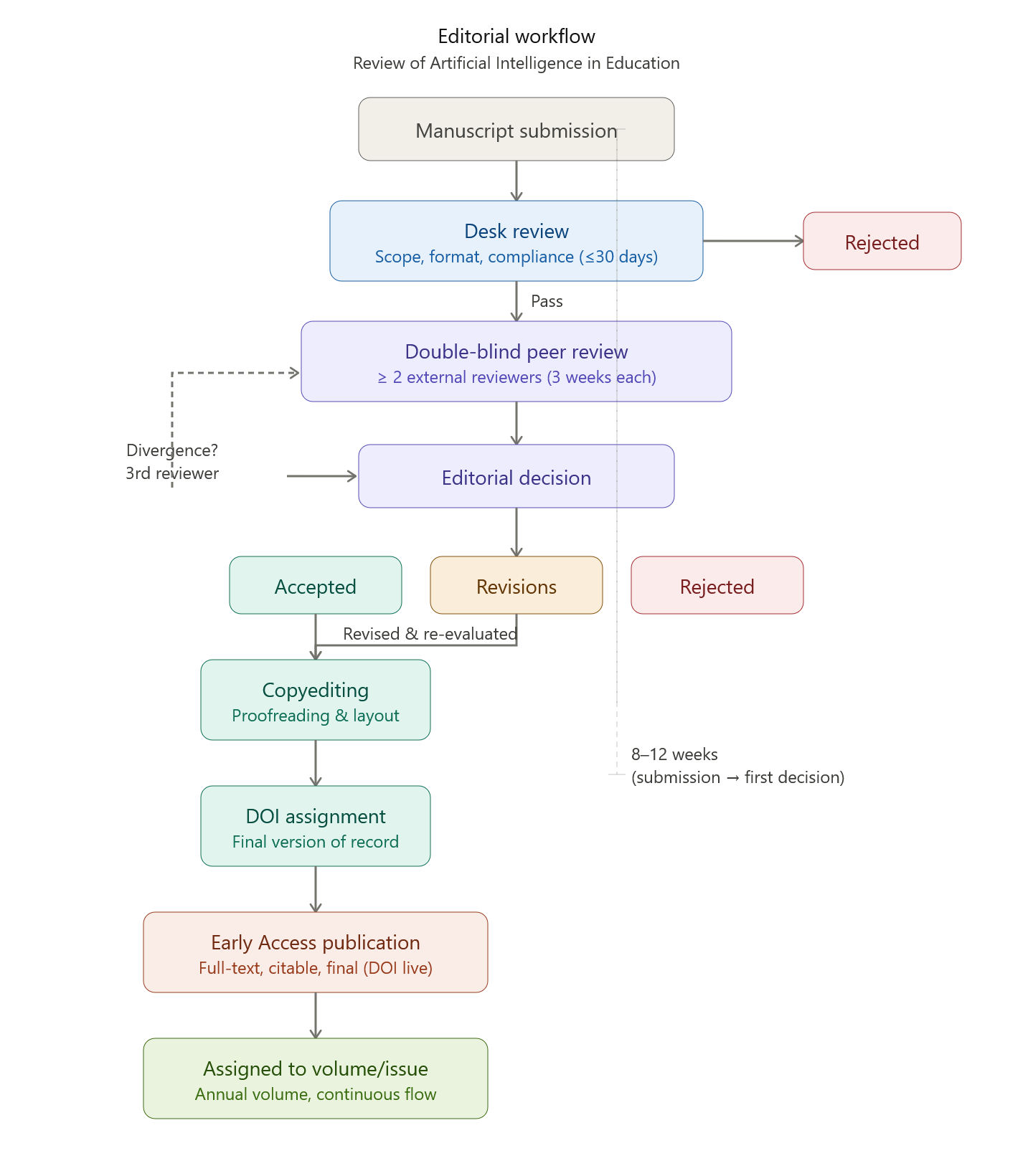
Stage 1 — Manuscript Submission. The corresponding author submits the manuscript through the OJS platform, accompanied by the Journal Publishing Agreement Form, conflict of interest declaration, and other required documents.
Stage 2 — Desk Review. Editors evaluate, without author identification, the relevance of the manuscript to the journal's scope, methodological adequacy, and compliance with editorial guidelines. Plagiarism screening (Crossref Similarity Check / iThenticate) is performed at this stage. Estimated timeline: up to 30 days. Outcome: forwarded for peer review or reasoned rejection.
Stage 3 — Double-Blind Peer Review. The manuscript is sent to at least two external and independent reviewers affiliated with stricto sensu graduate programmes. Reviewers have no access to the identity of the authors, and vice versa. Estimated timeline per reviewer: 3 weeks. In case of divergent opinions, a third reviewer may be invited.
Stage 4 — Editorial Decision. Based on reviewer reports, the Editor formulates a recommendation forwarded to the Editor-in-Chief for a final decision. Possible outcomes: Accepted, Minor Revisions, Major Revisions, or Rejected.
Stage 5 — Author Revisions (if applicable). Authors incorporate the requested corrections and resubmit the revised manuscript, which is re-evaluated by editors and/or reviewers.
Stage 6 — Copyediting, Proofreading, and Layout. The accepted manuscript undergoes spelling, grammar, and editorial standards review, followed by typesetting and final composition.
Stage 7 — DOI Assignment and Early Access Publication. The article receives its DOI and is published immediately on the journal's Early Access page as a final full-text, fully citable article.
Stage 8 — Assignment to Volume/Issue. The article is formally assigned to the corresponding annual volume. The DOI remains unchanged.
Estimated Editorial Timelines
| Stage | Estimated Timeline |
|---|---|
| Desk review | Up to 30 days |
| Peer review (per reviewer) | 3 weeks |
| Submission to first decision | 8 to 12 weeks |
| Author revisions (when applicable) | Depending on revision scope |
| Copyediting, proofreading, and layout | 2 to 4 weeks after final acceptance |
| Early Access publication | Immediate upon production completion |
Note: The timelines indicated are estimates and may vary depending on reviewer availability, the complexity of requested revisions, and the volume of submissions received. The journal is committed to providing timely status updates to authors throughout the entire editorial process.
17. Journal Revenue Sources
In accordance with the Principles of Transparency and Best Practice in Scholarly Publishing, the journal discloses its revenue sources and business model.
The Review of Artificial Intelligence in Education operates as a Diamond Open Access journal. All operational costs — including hosting, digital preservation, editorial management, copyediting, layout, and DOI registration — are funded entirely by the publisher, Editora Alumni IN. The journal does not charge article processing charges (APCs), submission fees, or any other fees to authors, readers, or institutions.
The journal does not accept advertising, sponsorships, or any form of commercial revenue that could influence editorial decisions or the integrity of published content. Revenue sources for the publisher may include institutional support, voluntary partnerships, and other publishing activities of Editora Alumni IN that are entirely separate from editorial decision-making.
This financial model ensures that editorial independence is fully preserved and that no financial considerations influence the acceptance, rejection, or publication of scholarly work.
Contact Information
Last Updated: May 2026
For questions regarding editorial policies, publication ethics, or complaints, please contact the Editor-in-Chief via the journal's official contact channels.
Publisher: Editora Alumni IN
Journal Website: https://educationai-review.org/revista/index