
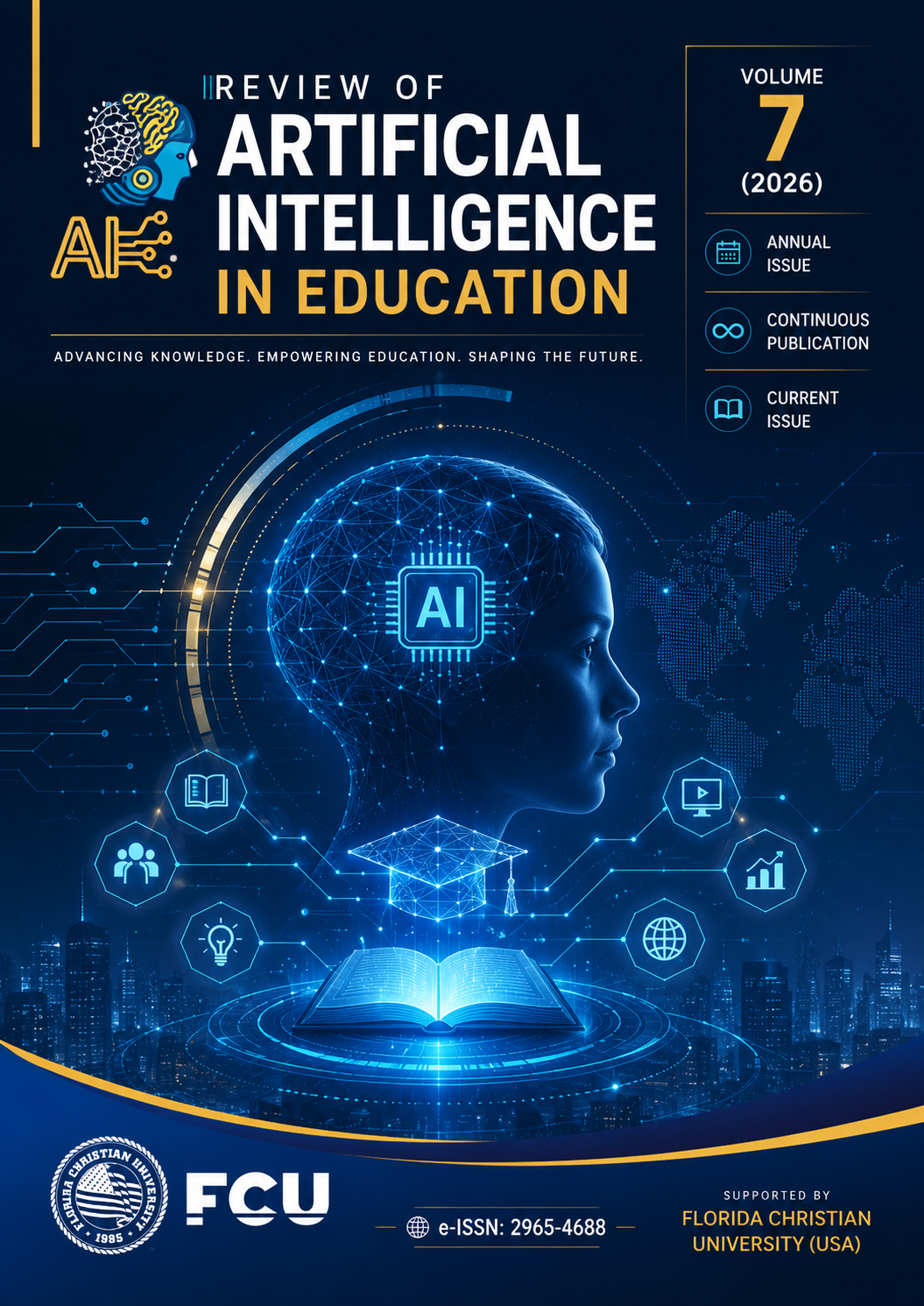
Review of Artificial Intelligence in Education

Current Issue

Vol. 7 No. i (2026)
Published March 19, 2026

The Review of Artificial Intelligence in Education is an academic journal dedicated to exploring and disseminating cutting-edge research on the applications of artificial intelligence (AI) in education. The journal provides a rigorous platform for critical analysis and discussion of AI-driven technologies, methodologies, and innovations that are shaping educational practices, governance, and management. The journal is proudly supported by Florida Christian University (EUA), reinforcing its commitment to academic excellence, ethical research, and global collaboration in the field of AI and education.

Our mission is to foster an interdisciplinary dialogue among scholars, researchers, and professionals from education, business, public administration, and technology, bridging AI advancements with organizational and strategic aspects of educational institutions. We welcome empirical and theoretical contributions that examine the role of AI in enhancing learning, optimizing institutional decision-making, improving corporate training programs, and redefining business models in the educational sector.

Additionally, the journal seeks to address the economic, ethical, and managerial implications of AI in education, offering insights into EdTech entrepreneurship, policy-making, and institutional governance. By embracing a multidisciplinary perspective, we aim to advance knowledge on how AI can drive efficiency, innovation, and sustainability in education and training environments.

Articles

Corey H. Basch, Grace C. Hillyer, Victoria H. Wagner, Charles E. Basch
e074
Media Framing of Artificial Intelligence in Education: A Content Analysis of US News Coverage
PDF
DOI: https://doi.org/10.37497/rev.artif.intell.educ.v7ii.74
Xia Yang
e075
CRAILF: A Zero-Cost Python-Based Gamified Framework for Enhancing AI Literacy Among Rural High School Students
PDF
DOI: https://doi.org/10.37497/rev.artif.intell.educ.v7ii.75
Sharlene Baksh
e062
Developing the CHAT Framework for Ethical Instructor-AI Integration: A Mixed Methods Study in Trinidad and Tobago
PDF
DOI: https://doi.org/10.37497/rev.artif.intell.educ.v7ii.62
Phineas Sebopelo, Nnenna Nancy Chukwuma
e078
Perceived Service Quality and Students' Use of AI Tools: The Moderating Effects of Students' Gender, Age, Country, and Level of Study
PDF
DOI: https://doi.org/10.37497/rev.artif.intell.educ.v7ii.78
Deivison Shindi Takatu, Fabrício Tonetto Londero
e080
Brazilian Education, Discipline, and Algorithms: Tensions Between Control and Autonomy in the Digital Era
PDF
DOI: https://doi.org/10.37497/rev.artif.intell.educ.v7ii.80
Yves-Frédéric Livian
e059
The role of generative AI for academic writing: A risk of disappearance of students skills? A reflection in the French Context
PDF
DOI: https://doi.org/10.37497/rev.artif.intell.educ.v7ii.59
Adit Gupta, Bharti Tandon, Nishta Rana
e082
Beyond Technology Acceptance: Validating a Multidimensional AI Integration Readiness Scale for Teacher Educators
PDF
DOI: https://doi.org/10.37497/rev.artif.intell.educ.v7ii.82
David Ming, Tonny Andrian Stefanus
e067
Integrating Artificial Intelligence into a Digital Sacred Space Framework to Enhance Virtual Fellowship in Sustainable Education
PDF
DOI: https://doi.org/10.37497/rev.artif.intell.educ.v7ii.67
View All Issues